For over a decade, the ELK Stack—Elasticsearch, Logstash, and Kibana—has been the gold standard for log aggregation, full-text search, and system monitoring. Engineers know the routine: write regex patterns, craft complex Lucene queries, parse JSON outputs, and decipher dashboards during a 3:00 AM production outage.
While ELK has always been fast, it has traditionally been reactive and literal. It answered exact queries, but it couldn't infer context, deduce intent, or synthesize root causes.
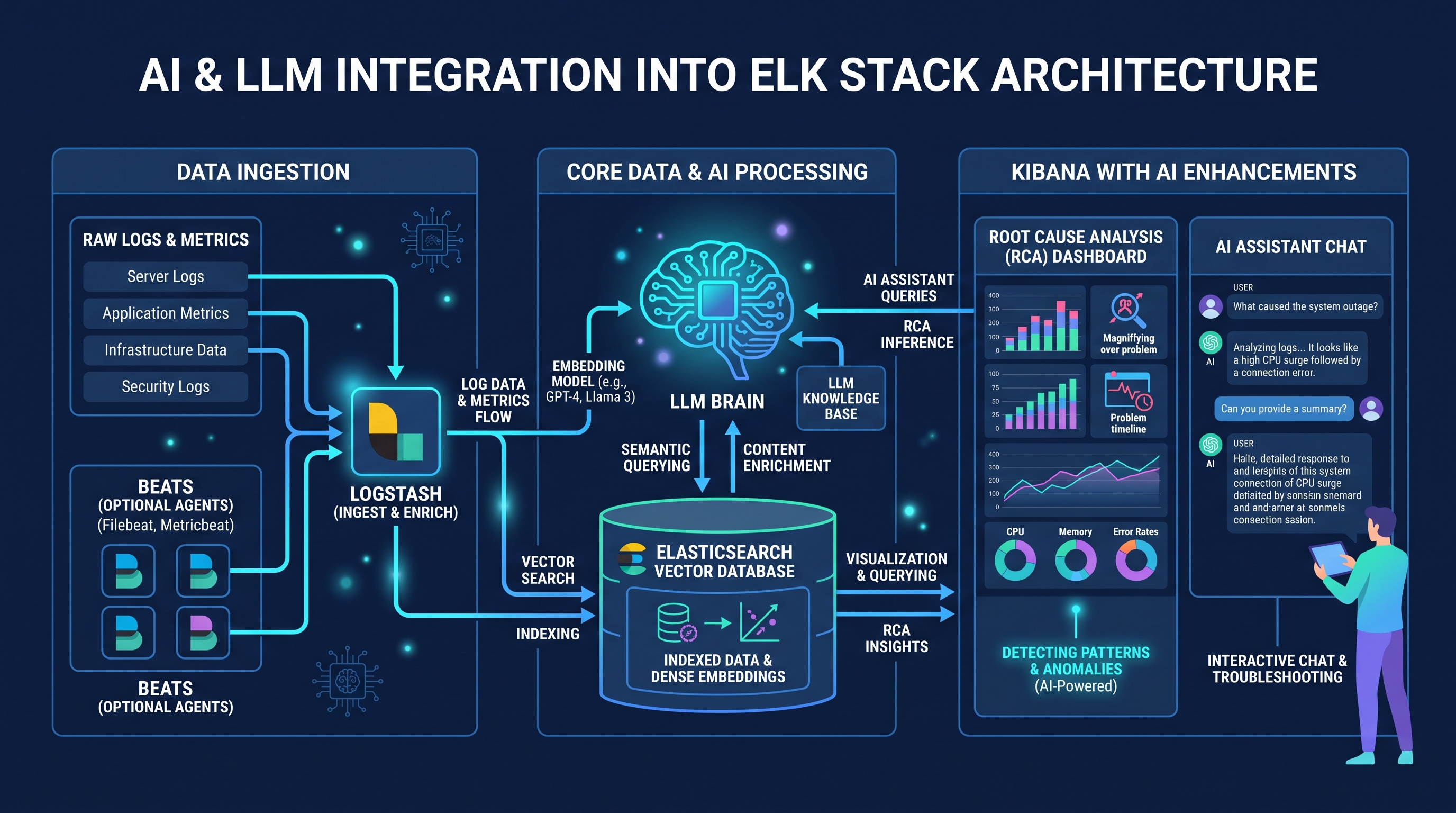
That reality is undergoing a seismic shift. By infusing Artificial Intelligence (AI) and Large Language Models (LLMs) into the ELK ecosystem, modern architectures are moving from simple log indexing to autonomous operational intelligence.
1. Natural Language Queries: Goodbye Complex Lucene Syntax
The Problem
Finding an elusive issue in Kibana traditionally required deep familiarity with Lucene Query Syntax (KQL/EQL) or building intricate nested filters:
service.name: "auth-gateway" AND http.response.status_code: [500 TO 599] AND NOT tags: "canary"For newcomers, product managers, or support engineers, navigating raw query bars is a barrier to entry.
The AI Advantage
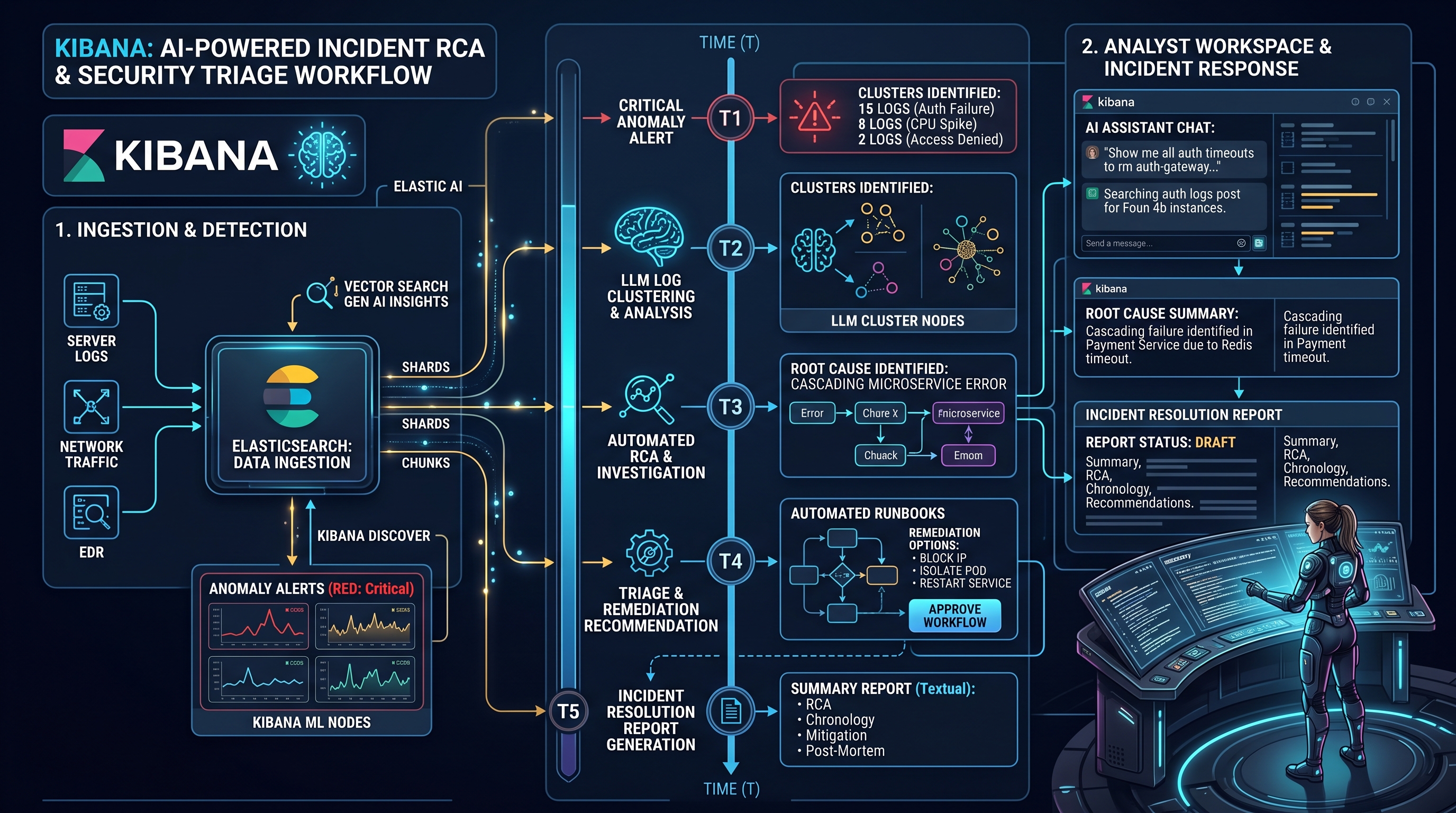
With LLMs integrated into Kibana (such as Elastic AI Assistant and generative copilot features), operators can ask questions in plain English:
"Show me all authentication timeouts occurring right after the latest rolling deployment in the EU region."
The LLM translates natural intent into optimized Elasticsearch queries, executes them, and formats the output into readable tables or graphs. This democratizes data access across Dev, Sec, and Ops teams.
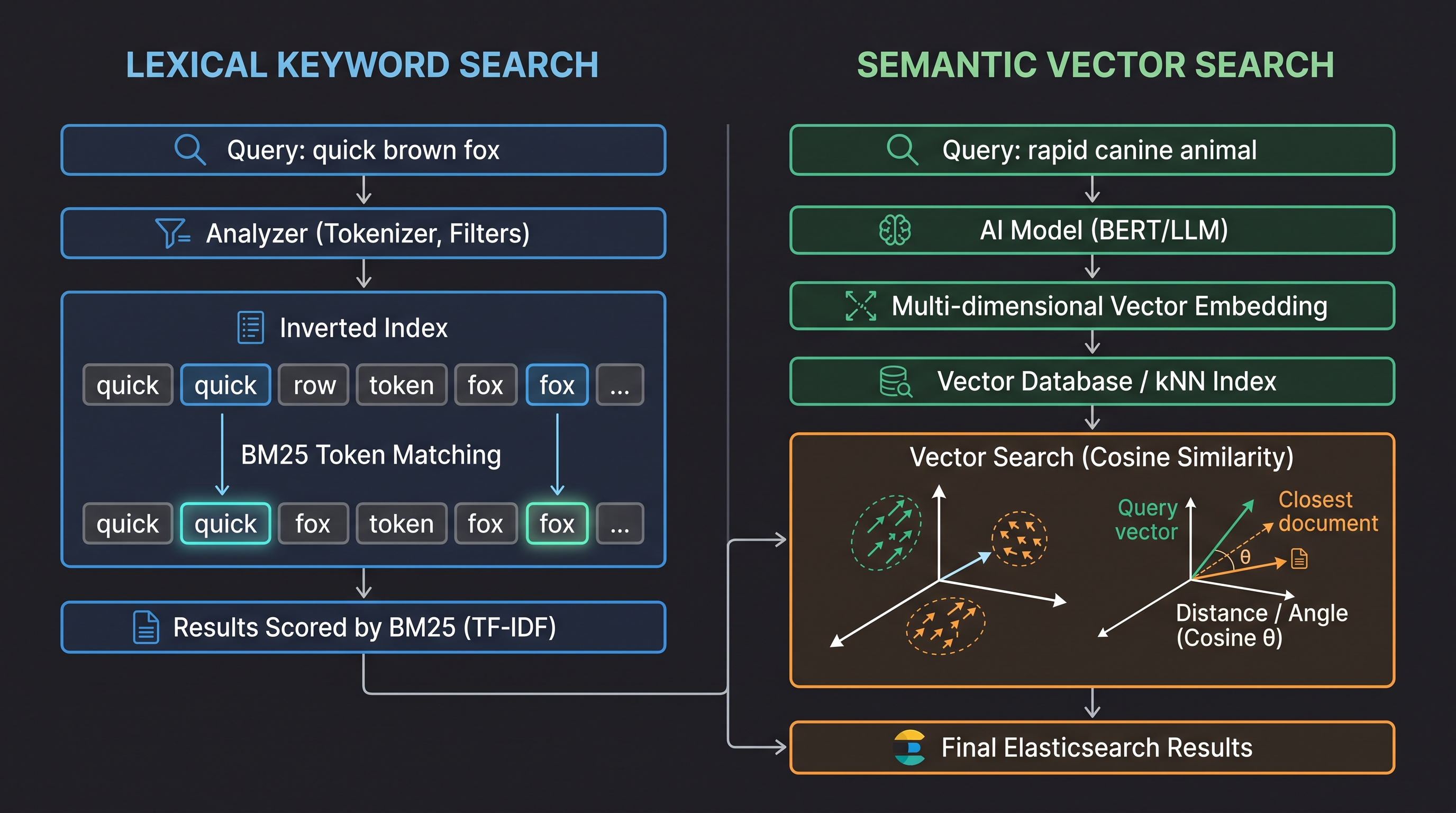
2. From Lexical to Semantic: Vector Search & Hybrid Retrieval
Elasticsearch has expanded significantly beyond inverted indices by adding vector search and Approximate Nearest Neighbor (ANN) algorithms.
| Feature | Lexical (Traditional BM25) | Semantic Search (Vector Embeddings) |
|---|---|---|
| Matching Mechanism | Exact keyword/token match | Dense vector cosine similarity |
| Typo & Synonym Handling | Requires manual synonym filters | Handled natively by semantic meaning |
| Domain Understanding | Misses nuances (e.g., "OOM" vs "Out of Memory") | Treats related operational terms identically |
By combining standard BM25 lexical search with vector embeddings (Hybrid Search via Reciprocal Rank Fusion), the ELK stack captures both exact transaction IDs and high-level behavioral patterns.
3. Context-Aware Root Cause Analysis (RCA)
When a microservice cascade failure occurs, traditional dashboards light up red with thousands of disparate error logs. Engineers often spend hours cross-referencing timestamps, stack traces, and API payloads.
How LLMs Step In:
- Log Summarization: Instead of scrolling through 20,000 stack traces, an LLM groups duplicate or related exceptions and produces an executive summary:
"92% of the errors are triggered by an unhandled Redis connection pool exhaustion on worker node 4b, causing cascading HTTP 504 timeouts across the checkout service."
- Remediation Playbooks: Integrated LLMs don't just point out the error; they reference internal runbooks or public CVEs to recommend concrete fixes:
"Suggested Fix: Increase
max_active_connectionsin your Redis config or restart podauth-service-7f89b."
4. Intelligent Anomaly Detection vs. Static Thresholds
Static alerting rules are notoriously brittle:
- Set an alert threshold too low: Alert fatigue.
- Set it too high: Missed outages.
Machine learning models within Elasticsearch continuously learn baseline system behaviors, seasonal patterns (e.g., Black Friday traffic vs. Tuesday night traffic), and correlation spikes across multiple services. Instead of waking engineers for a harmless traffic spike, the system flags genuine statistical anomalies that correlate with error rates.
5. Security & Threat Hunting (Elastic SIEM + Generative AI)
In modern Security Operations Centers (SOCs), analysts face relentless event streams. AI transforms the security workflow in several key ways:
- Attack Path Reconstruction: LLMs can assemble fragmented audit logs, lateral movement events, and DNS queries into a chronological narrative of an attack.
- Automated Rule Creation: Security engineers can describe an emerging threat scenario in text, and the AI translates it into an Elastic Detection Rule or Sigma rule.
- Alert Triage: LLMs assess log context against MITRE ATT&CK frameworks, scoring real threats while auto-closing benign false alarms.
The Road Ahead: An Intuitive Observability Fabric
The convergence of the ELK Stack with AI and LLMs changes the developer and SRE experience fundamentally:
- Logs are no longer just strings—they are context-rich narratives.
- Dashboards are no longer static—they are interactive conversational interfaces.
- Troubleshooting shifts from reactive fire-fighting to guided, proactive resolution.
By turning raw log data into structured reasoning, the AI-powered ELK stack lets teams spend less time parsing stack traces and more time shipping resilient code.